Singapore’s humidity is relentless. That 80%+ air, creeping in from open windows around Aljunied or Eunos, doesn’t just feel oppressive — it quietly swells solid wood joints and can warp cheaper veneers over a few seasons. For a TV console that’ll sit against a living room wall for years, buyer wants a material that won’t bow or split. Engineered wood with a moisture-resistant core, often laminated with a durable finish, typically outperforms solid teak in these conditions; it’s built to handle the climate, not just look good on arrival.
Dust is another local constant. Open windows invite a fine grey film onto everything, which means open-shelf consoles become a weekly dusting chore. Closed cabinets, with proper doors that seal, mitigate that problem significantly — they keep your media gear and cables clean while hiding the visual clutter of wires and remote controls. That’s a practical win for any family living near construction or in a high-traffic neighbourhood.
Space dictates the proportions. In a compact 4-room BTO living room, a console that’s 35cm deep rather than the standard 50cm can prevent the area from feeling crowded, leaving clearer walking paths around the sofa. Elevated legs, or a fully floating wall-mounted design, also ease robot vacuum access underneath — a small detail that matters in daily upkeep. For truly tight spaces, like a 12 sqm common bedroom used as a media den, wall-mounted units free the entire floor space, creating a cleaner look and simplifying cleaning.
Consider the overall footprint against your actual room. A 240cm console might fit a 75-inch TV, but in many homes it’ll dominate the wall and leave little room for side tables or plants. Shallow depth and clean lines help the piece feel integrated, not intrusive. For options that balance these local priorities, you can browse the TV console range at Megafurniture, where engineered wood and closed storage designs are common.
Good runners are a silent investment. You'll notice cheap ones when they start sagging under a pile of game controllers, sticking halfway through their travel. Full-extension, soft-close mechanisms are the baseline for a reason—they allow you to see and reach the entire drawer's contents, which is crucial when you're fumbling for a specific HDMI cable behind the router. That smooth, weighted glide on steel bearings feels substantial and won't degrade after a few months of use. In a humid climate, plastic wheels or thin side rails can warp or bind, leaving you with a drawer that scrapes and jams. It's a small component that speaks volumes about the whole unit's lifespan.
Press your knuckles against the side panels. If they sound hollow or flex under gentle pressure, you're likely looking at 12mm or even 9mm board, which simply won't hold up. For a TV console that needs to bear weight and resist racking, 18mm is the practical minimum for carcases and shelves. Thinner boards, often found in flat-pack bargains, can bow over a 180cm span, especially when loaded with a centre channel speaker and a collection of hardcover books. That extra millimetre count provides the rigidity needed to keep everything square and stable for years. It’s the difference between furniture that feels like a permanent fixture and something that feels temporary.
Sunlight streaming through your BTO living room window is a finish's worst enemy. Standard lacquers or low-pressure laminates will fade noticeably within a year, leaving a ghostly outline where a vase once sat. UV-cured acrylic or polyester finishes are essentially baked onto the board, creating a hard, non-porous surface that resists fading, most stains, and even minor scratches. This means the rich walnut or matte black you chose will stay true, even in a sun-drenched corner near your sliding balcony door. It’s a technical specification that directly combats a very specific, very common Singaporean environmental challenge.
Peeling edges are a telltale sign of poor construction and high humidity. Look for tightly sealed edges with no visible gaps or raised bubbles—these are moisture entry points. Thermally fused melamine or high-pressure laminates with proper PVC or ABS edging are far more resilient than simple foil or paper wraps glued onto particleboard. In our climate, that adhesive can fail, leading to unsightly curls at the corners that catch dust and eventually tear. A well-finished edge should feel seamlessly part of the board, not a separate layer waiting to delaminate.
Wall-mounted or floating consoles demand internal skeletons. The allure of a clean, levitated look vanishes quickly if the unit sags or pulls away from the plasterboard under a 30kg OLED TV. Internal steel braces or a full metal frame are non-negotiable for these styles, effectively turning the furniture into a cantilevered shelf. Always check the stated weight capacity against your actual gear—a 65-inch panel plus a solid soundbar can easily surpass 40kg. That weight isn't static either; it shifts when you connect new devices. Proper reinforcement is what lets you trust the floating illusion completely.
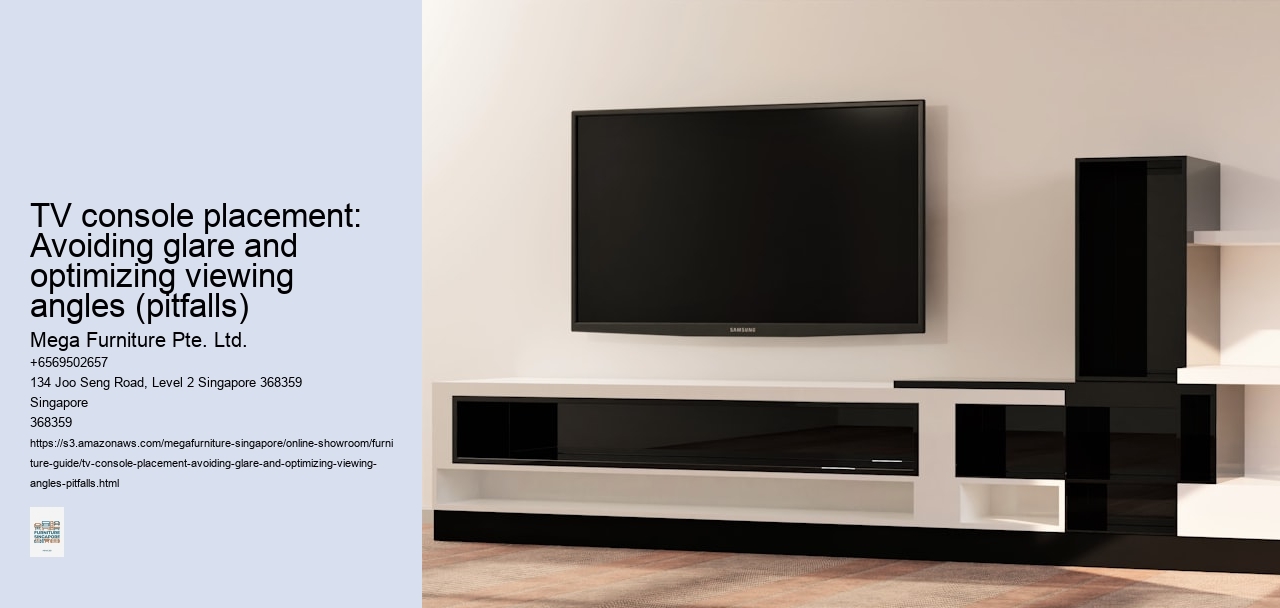
It’s a classic Singaporean scene: the afternoon sun blasting through the opposite block’s window, turning that expensive OLED screen into a useless mirror. Buyers often measure for their 75-inch TV but neglect the console, ending up with a unit that’s a good 30cm too short; the resulting top-heavy silhouette looks perpetually unstable, like it might pitch forward during the next dramatic movie scene.
That visual instability is just the start. Forgetting to plan for cable management conduits leaves a nest of router, HDMI, and power wires spilling onto the floor—a particular eyesore in a minimalist media wall setup. It’s a hassle that becomes obvious only after everything’s mounted, forcing owners to either live with the clutter or embark on a messy retrofit.
More critically, many place the console against a wall shared with a wet area, like the common bathroom in a 4-room BTO. The constant, hidden humidity from pipes and showers can warp MDF boards and laminate finishes within a year; it’s a slow-motion damage that voids warranties and ruins the unit’s structure. Solid wood or treated materials offer more resistance, but the real fix is simply choosing a different wall.
Another common oversight is ignoring future-proofing. A console with just enough space for today’s gaming console and soundbar leaves no room for the added set-top box, media player, or second console that inevitably arrives. Opting for a longer unit, around 200cm or more, with a mix of enclosed and ventilated compartments, organises today’s tech and accommodates tomorrow’s. For those planning their layout, browsing the options for a proportionally sized console is a sensible first step.
A product shot online can’t tell you if a 180cm console will swallow the light in your narrow BTO living room or just look lost. That’s why a trip to a showroom like Megafurniture’s in Joo Seng or Tampines is less about browsing and more about a forensic check—you’re there to test the unit in a mock-up HDB setting, where proportions become real. The critical step is verifying the finish under Singapore’s specific lighting. A laminate that looks like warm oak under studio lights can skew grey and clinical under the cool LEDs common in many flats; a glossy top might cast a permanent glare from your window at Marine Parade. You need to see the texture up close, run a hand over it, and judge if it holds up to the afternoon sun from your west-facing window. Then, get hands-on. Open every drawer and door—the action should be smooth and silent, not a gritty slide that announces every use. This is where you test the storage promise. Bring a mental checklist: will the central cavity actually fit a StarHub set-top box, a PlayStation 5, and an AV receiver with proper ventilation? Can the drawers organise a tangle of cables and remotes? A console that looks capacious in a photo often reveals its shallow depths or obstructive centre supports in person. It’s a tangible process that sidesteps the costly mismatch of an online purchase. You’ll know if the 210cm model you wanted for your 75-inch TV overpowers your 4-room layout, or if a floating design feels sturdy enough for your soundbar. That physical confirmation—of scale, touch, and function—is what makes the trip to
Megafurniture’s collectiona necessary final step before committing.
The delivery crew will arrive, but your 2.4-metre TV console crate won't fit past the lift landing. In many HDB blocks and older condos, that final 90cm corridor turn is the real bottleneck; oversized packaging simply can't make the corner. Confirm with the retailer that your unit will be delivered partially dismantled—flat-packed panels are a hassle, but they're the only way a long console gets to your door without a crane.
Assembly itself demands preparation. For a floor-standing unit over two metres, you'll need a drill, a spirit level, and a second person. Trying to align a 240cm frame solo is a recipe for a wobbly, misaligned finish that'll annoy you every time you look at it. Those weekend surcharges for condo deliveries aren't just a cash grab; they reflect the limited loading bay access and strict timing windows that drivers navigate across neighbourhoods from Tampines to Queenstown.
Then there's the warranty fine print, which often reads like a list of Singaporean realities. High ambient humidity isn't a manufacturing defect; it's a common cause of wood warping or veneer lifting that many basic warranties explicitly exclude. Similarly, gradual finish wear from daily dusting or sun exposure from that west-facing window in your BTO living room might not be covered. You're looking for a policy that offers at least three years on hardware—drawer runners, hinges, and mounting brackets—as these are the components that bear the brunt of daily use.
It's a pragmatic trade-off: a lower upfront price might mean accepting a one-year warranty that offers little real protection against the local climate. The most common disappointment isn't a sudden breakage, but the slow-motion failure of a drawer that won't close properly after 18 months in a humid flat.
The search history for TV consoles in Singapore tells a specific story—it’s less about cinematic dreams and more about navigating the hard limits of a 4-room BTO living room and a curious terrier. The questions are precise, born from real constraints.
For a 55-inch TV in a typical HDB layout, you’ll want a console at least 180cm long. That’s the safe minimum; it prevents the TV from looking comically oversized on a too-short plinth and gives you decent flanking space for bookshelf speakers or a decorative item. Going up to 200cm or even 220cm is better if your wall allows it, creating a more anchored media wall feature.
Pet owners scratching their heads over material should avoid softwoods and thin veneers. Opt for textured laminates, sintered stone, or sealed solid wood like oak—surfaces that can withstand a clawing session without showing every mark. A floating TV console can be perfectly safe in an HDB, but it’s entirely dependent on the wall. You must mount it into the reinforced concrete structural wall, not the partition blocks; a qualified installer will use a scanner to find the studs and proper anchors.
And that router question is a classic HDB puzzle. If your console has no back panel, you’re trading airflow for a messy look. The simplest fix is to use a small, dedicated storage box placed on a lower shelf to hide the router and its blinking lights while letting heat dissipate—just ensure it’s not fully enclosed. For a cleaner setup, some buyers choose a console with a perforated metal back panel or a dedicated cable management compartment.
Measure that wall twice, then tape the console's exact outline on your floor. It's a tedious step, but it prevents the classic miscalculation where a 200cm console swallows an entire BTO feature wall, leaving no breathing room for your floor-standing speakers or that cherished IKEA Kallax unit you can't bear to part with. You're not just confirming fit; you're visualising the new centre of gravity for your entire living room layout.
Alignment is everything. Verify the power point and data port locations against your taped outline—if they fall dead centre behind your planned unit, you'll need to factor in cable management grommets or a slightly off-centre placement. Plan for LED strip lighting now, too; running a discreet USB power line behind a floating console is simple during installation but a frustrating rewiring job later. In many 4-room flats, that soft backlight becomes the primary ambient source, transforming a black screen into a feature at night.
This is where you decide if the console must anchor the aesthetic or quietly recede. A bold, sintered stone unit in Tampines Grey commands attention, dictating your colour palette and even your sofa choice. A muted, walnut-veneered design, however, lets your 65-inch TV and artwork take centre stage. There's no right answer, but committing to one role avoids a piece that shouts and whispers at the same time.
Finally, balance storage need against visual clutter. Deep drawers hide router spaghetti and gaming peripherals beautifully, but a bank of full-height cabinets on a 180cm console can feel oppressively heavy in a compact space. Sometimes, a mix works best: enclosed storage for the mess, and a single open shelf for a curated stack of books or a solitary ceramic vase. The goal is to contain the chaos of daily life without building a monolithic wall of doors; after all, you bought a TV to watch it, not to stare at another cupboard.
In a typical four-room BTO flat, the living room wall facing the sofa is often precisely 1.9 metres wide-that's the space you're working with, and it dictates everything. Display cabinets sit between bookshelf and storage cabinet in function — closed glass-front protection for the items you want visible but not collecting dust. Megafurniture's Display Cabinet range covers glass-front, curio, wall-mounted, and freestanding configurations in solid wood, MDF, and metal-framed constructions. Average pricing for glass-front variants sits around $271, with LED-lit and motorised-shelf models commanding the higher tier.. A console longer than that will clash with door frames or awkwardly overlap a service riser; one too deep will choke the 1.2-metre walkway left for navigating past. A TV console anchors the wall opposite the sofa in the same way a tall bookshelf anchors a corner — long horizontal piece, mix of open and closed storage, defines the visual weight of one whole side of the room. Megafurniture's TV Console range covers floating wall-mounted designs, low-profile freestanding consoles, and modular feature-wall configurations. Most pieces sit at 40-50cm height, sized for screens up to 75 inches.. It's a tight equation, where every centimetre of depth matters as much as length. Condo layouts offer more breathing room, with media walls that can stretch four metres or more. That expanse tempts you toward a longer, more substantial piece, but you'll still need to mind the aircon unit's airflow path-placing a tall back panel directly in front of a blower is a common, costly mistake. The priority here shifts from pure fit to intentional proportion; a 240-centimetre console can anchor the space without dominating it, provided it's kept low and clean-lined. Resale flats and landed homes introduce irregularity-jutting columns, odd alcoves, or non-standard window placements that break a clean wall line. Here, the console's dimensions become a negotiation with the architecture itself. You might need a modular pair of units to skirt a structural beam, or a shallower depth to preserve circulation around a favourite armchair. It's less about standard sizes and more about custom-fit thinking. For most local homes, the ideal depth sits around 40 to 45 centimetres. A Bookshelf earns its place in Singapore homes through dual function — book and decor storage in the open shelves, soft visual division when placed mid-room in open-plan condominium layouts. Megafurniture's combined display unit and bookshelf hub covers tall book racks, cubby-hole designs, ladder shelves, modular cube systems, and glass-door pieces in oak, walnut, and MDF veneer finishes. Solid-wood pieces typically start around $425, with most heights spanning 120cm to 220cm to fit standard 2.6m HDB ceilings.. That's enough to house an AV receiver and a game console without protruding into the room, yet shallow enough to keep walkways clear. Length should mirror the TV above, with a 180 to 200-centimetre console now the
common favouritefor 65-inch screens, which have become the new centrepiece in upgraders' living rooms. The old rule of a console longer than the TV still holds-it just looks more balanced, less like an afterthought. Ultimately, your room's blueprint writes the first draft of your requirements. Ignoring those fixed points for a console you've seen elsewhere leads to daily friction; a piece that fits the typology disappears into the room's function. That's the quiet goal.
In a typical four-room BTO flat, the living room wall facing the sofa is often precisely 1.9 metres wide—that’s the space you’re working with, and it dictates everything. A console longer than that will clash with door frames or awkwardly overlap a service riser; one too deep will choke the 1.2-metre walkway left for navigating past. It’s a tight equation, where every centimetre of depth matters as much as length. Condo layouts offer more breathing room, with media walls that can stretch four metres or more. That expanse tempts you toward a longer, more substantial piece, but you’ll still need to mind the aircon unit’s airflow path—placing a tall back panel directly in front of a blower is a common, costly mistake. The priority here shifts from pure fit to intentional proportion; a 240-centimetre console can anchor the space without dominating it, provided it’s kept low and clean-lined. Resale flats and landed homes introduce irregularity—jutting columns, odd alcoves, or non-standard window placements that break a clean wall line. Here, the console’s dimensions become a negotiation with the architecture itself. You might need a modular pair of units to skirt a structural beam, or a shallower depth to preserve circulation around a favourite armchair. It’s less about standard sizes and more about custom-fit thinking. For most local homes, the ideal depth sits around 40 to 45 centimetres. That’s enough to house an AV receiver and a game console without protruding into the room, yet shallow enough to keep walkways clear. Length should mirror the TV above, with a 180 to 200-centimetre console now the
common favouritefor 65-inch screens, which have become the new centrepiece in upgraders’ living rooms. The old rule of a console longer than the TV still holds—it just looks more balanced, less like an afterthought. Ultimately, your room’s blueprint writes the first draft of your requirements. Ignoring those fixed points for a console you’ve seen elsewhere leads to daily friction; a piece that fits the typology disappears into the room’s function. That’s the quiet goal.